About Belarus
Articles dedicated to Belarus history, Belarus politics, Belarus economy, Belarus culture and other issues and Belarus tourist destinations.Baranovichy or Baranowicze (Western Belarus)
Capitalism development and the growth of the domestic market along with economic and strategic considerations forced the tsar government of the Russian Empire to start building the railway.
Baranovichy is mentioned in writing in 1706 in the description of the campaign of Karl XII. The modern city emerged from the railway station settlement (the station unveiled in 1871) that got its name from a nearby village. Not far from the station Baranovichy-Central railway maintenance infrastructure was built based on the land of the Rozvadovskies family. The latter put a lot of effort to upgrade the area and change the status of the settlement into borough in 1884 having 1500 residents by then.
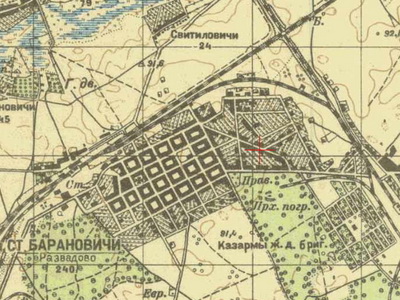
Baranowicze area old map (1900s)
About two miles to the west from Baranovichy Station that lay on the way from Moscow to Brest the station called Baranovichy-Polesskiye was built connecting Vilno and Pinsk. New Baranovichy – the railway settlement – became the second core of today’s district center Baranovichy connected with the first one by a short stretch of railway. In 1890 the two settlements became one and the new name for both was Baranovichy-Rozvadovo, Minsk Gubernia.
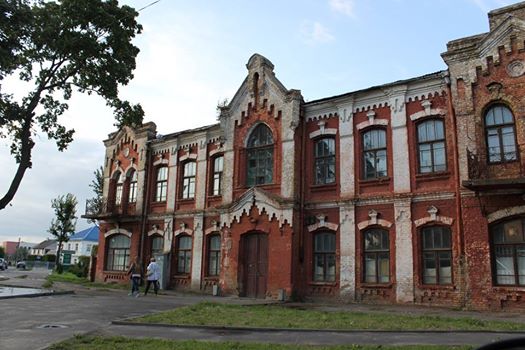
Typical early 20th century mansion
The tranquil countryside area became a major railway hub connecting Russia, Poland, the Baltics and Ukraine. The military put up a factory for ship biscuits, alcohol refinery and a number of barracks with several battalions attached to the area. These activities and the increasing railroad traffic attracted more labor force. In 1895 railroad shops appeared to fix train engines and water supply equipment.
In 1897 there under 9 000 people were living in the borough, half of them Jews in spite of the ban to live in rural areas that was active until 1903. In 1899 the borough featured 151 shop.
In the early 20th century there were more residents in Baranovichy than in the area center Novogrudok but since the former was not a town sanitary, development and fire safety standards of the towns didn’t apply to it.
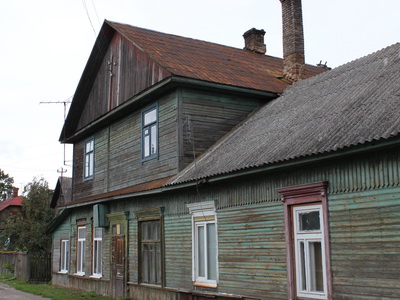
A rich house in Baranowicze, 1930s
There wasn’t a church or a hospital in the borough though its population grew rapidly – from 12 000 in 1903 to 30 000 in 1913. Three brick factories, ship biscuit factory and mills were running, a telephone exchange was commissioned along with seven primary schools, pharmacies, a movie theatre and a church. But most buildings were wooden and out of 35 streets only one was paved.
WWI affected Baranovichy severely – the locals were forced to flee by the Russian army that destroyed whatever property it failed to take along. Most Jewish population stayed behind to live through the German occupation. Before that set in the Headquarters of the Chief of Staff of the Russian army (Nicholas II) was located in Baranovichy.
The Riga Peace Treaty of 1921 saw Baranovichy run by Poland until 1939. By 1941 about 10 000 Jews lived in Baranovichy, the town being a railway hub with growing economy. It also enjoyed vibrant educational and political life with all Jewish organizations registered in Poland at the time taking active part.
Around 25 per cent of Jews who were very poor received aid funds from different agencies including Joint. Subsequently their relocation to foreign countries such as the USA, Australia, Canada and New Zealand took place often sponsored by such agencies. The feeling of the oncoming disaster stepped up these migration trips in the late 1930s.

Firefighting station in Baranowicze, 1930s (still in use)
The Nazi occupation took place between 27 June 1941 and 8 July 1944 and saw the creation of a ghetto and two death camps with 100 000 POWs and civilians being killed there. The ghetto accounted for about 12 000 deaths.
Today Baranovichy is a major industrial center in Brest region and an important transportation hub. It has about 500 streets and its population reaches about 170 000 people making it the 8th largest city in Belarus. The railway tracks running from north-east to south-west and from north-west to south-east cut the city into four separate districts.
If you wish to take a private guided tour to Baranovichy or research your Baranovichy ancestry, I will be happy to assist )
|
|
Questions are welcome!


Featured
Applying at their local Belarus Consulate, the citizens of migration-secure states (e.g. the USA, Canada, Japan and others) can obtain a short-term...
The form of application for a visa to Belarus has become digital and you can save and send it as a PDF file. It is only a 2-page document that is available...
Quite a number of things, as a matter of fact. Let’s examine a typical case from my travel agent’s past with a traveler landing in Minsk Airport (MSQ) and applying for a visa...
People, who want to travel to Belarus to see a friend, take care of the grave of a relative, take part in the court hearings, etc. need to apply for a private visa...
This article covers field family research in Belarus that in most cases comes after dealing with the State archives of Belarus and genealogical research.
A plastic card is a fine thing, no doubt, but there have been a number of cases when the ATM displayed ERROR, or required a PIN code...
While most tourists agree that Belarus is not the country for grand shopping, there are still some things that can be brought back as souvenirs...