About Belarus
Articles dedicated to Belarus history, Belarus politics, Belarus economy, Belarus culture and other issues and Belarus tourist destinations.Folk crafts in Belarus: pottery
Pottery is another widespread craft in Belarus and is a part of the Belarusian culture.
Potters used clay to produce items for household and decoration. Pottery appeared in Belarus 4-3 thousand years BC when first ceramics – hand-shaped pots for cooking were produced in large numbers. With time they started to produce bowls, goblets, amphora and suchlike. The basic models and forms that were made in those times were then used for thousands of years. Some patterns have remained unchanged even up to date, e.g. a corrugated line is a symbol of water.
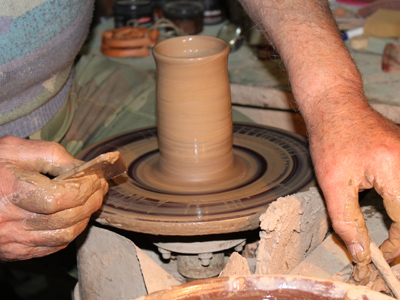
A potter at work in Dudutki Museum
In the 10th century in Kievan Rus a milestone pottery innovation was made – the potter’s wheel was introduced enabling craftsmen to mass-produce table ware and to improve its design. The forms were perfected. The main centers of pottery were in Polotsk, Turov, Smolensk and Neman areas.
When towns started to appear in Belarus, pottery became a separate craft where only men were involved. It was divided into urban and rural. While in the Belarusian villages craftsmen still produced tableware in hand and for their own use, the range of products being comparatively small, the town craftsmen actively adopted foreign technologies and designs.
The development of socioeconomic and political life in Belarus also contributed to the development of pottery in 16-18th century. In many towns including Grodno, Berestye, Minsk, Kopyl, Mir, Shklov and others potters were united into guilds. Among famous pottery centers also were Krichev, Kopys, Logoysk, etc. Pottery was also practiced in many villages. Export of ceramics meant high level of production quality. In the 17 century Belarusian tilers were invited to Moscow to decorate Intercession Church in Izmailovo, a gate church in Andreevsky Monastery, the Tower Palace and the Church of the Savior behind the gold bars in Kremlin.
In the cities with guilds potters settled close to each other forming streets that were often named Potter Streets. They had their charter according to which masters were accepted into the guild, foremen were elected, meetings were conducted, pupils were recruited and promoted, etc.
It took 4 to 6 hours to train a pupil after which he could work as an apprentice. Only a master could become a guild member and enjoy all respective rights. To achieve this, an apprentice had to exhibit his skills: produce a number of items of particular sizes: a pot, a bowl and an earthenware pot. Potters who earned a rank of a master had a right to open up a business of their own. Compared to rural craftsmen, urban potters perfected the technology, had more advanced tools and a wider range of products. Guilds were abolished in 1902 and since then every potter could have a workshop of his own.
In the 19th century pottery in Belarus had two directions: small-scale production (village family producers) and manufactory (wasn’t wide-spread, a number of shops in Borisov, Kopyl and Minsk). In the late 19 – early 20 centuries about 4-4.5 thousand people were in the pottery business. They met the demand of the country and exported products abroad, e.g. Grodno ceramics was sold to Warsaw, Vilnius and Kiev.
After 1917 potter artels were established and by 1930 the number of artel and private pottery businesses had been reduced (although before the war some shops in Belarus employed up to 300 craftsmen).
In the 1960s most potter artels were reorganized into state-run factories that still exist today in Borisov, Ivenets, etc. Conventional potteries still exist in Gorodnaya Village (Stolin Area), Porozovo Village (Svislosh Area), Ruzhany (Pruzhany Area) where old craftsmen still observe old traditions. Nowadays clay products make popular Belarus souvenirs.
|
|
Questions are welcome!


Featured
Applying at their local Belarus Consulate, the citizens of migration-secure states (e.g. the USA, Canada, Japan and others) can obtain a short-term...
The form of application for a visa to Belarus has become digital and you can save and send it as a PDF file. It is only a 2-page document that is available...
Quite a number of things, as a matter of fact. Let’s examine a typical case from my travel agent’s past with a traveler landing in Minsk Airport (MSQ) and applying for a visa...
People, who want to travel to Belarus to see a friend, take care of the grave of a relative, take part in the court hearings, etc. need to apply for a private visa...
This article covers field family research in Belarus that in most cases comes after dealing with the State archives of Belarus and genealogical research.
A plastic card is a fine thing, no doubt, but there have been a number of cases when the ATM displayed ERROR, or required a PIN code...
While most tourists agree that Belarus is not the country for grand shopping, there are still some things that can be brought back as souvenirs...