About Belarus
Articles dedicated to Belarus history, Belarus politics, Belarus economy, Belarus culture and other issues and Belarus tourist destinations.Belovezhskaya Puscha, one of the key attractions in Belarus
Belovezhskaya Puscha is a large national park that is located in the territory of two states – Poland and Belarus. The Belarusian part of the reserve is over 87 thousand hectares large, the Polish one – over 10 thousand hectares. The Belarusian part of Belovezhskaya Puscha is located in Kamenets and Pruzhany Areas of Brest Region and Svislosh Area of Grodno Region of Belarus. The administration of the reserve is located in Kamenyuki Village.
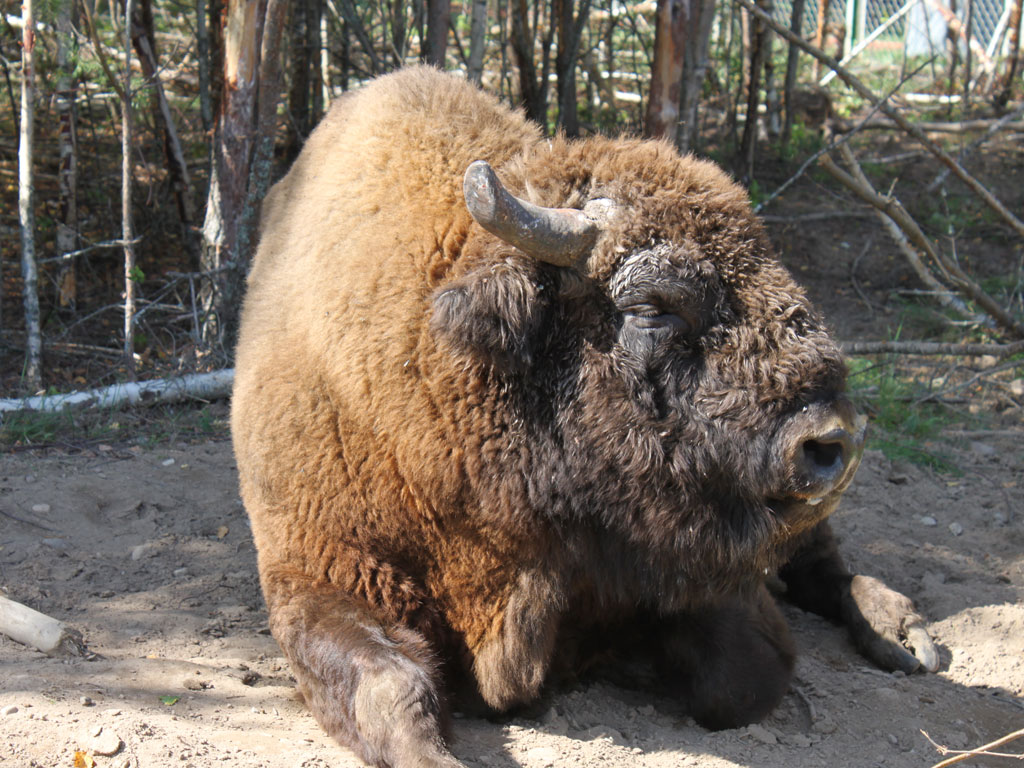
Belarus zubr - the symbol of the Reserve and of Belarus
Belovezhskaya National Park or Belovezhskaya Puscha– is the oldest reserve in Europe with a very long history. Kiev chronicles mentioned that the present-day territory of the forest was home to the tribes who specialized in fishing and hunting. In 1276 Kamenets fortified town was founded in Belovezhskaya Puscha. Since the late 13 century the forest belonged to Lithuanian dukes but was taken over by the Poles who introduced strict rules protecting wild animals in the early 15 century. The first factories that produced tar, tar oil and coal were established in the Belovezhskaya Puschain the middle of the 16 century.
In 1795 Belarus and Poland became Russian territories and the forest was divided into areas that were given to the top Russian officers who took part in the occupation of these lands. In 1811 the largest fire in the history of the forest broke out caused by drought and lasted from May till October. In the mid 19 century the forest was divided into blocks and since the 1860s the forest resources have been regularly monitored.
As before, Belovezhskaya Puscha remained the site for royal hunts, so attempts were taken to increase the population of game animals, mainly hoofed species. In 1802 Alexander I issued an edict prohibiting bison (Belarus zubr) hunt and in 1809 the detailed record of the zubr herd was made. The deer that were completely exterminated in 1705 were brought from Germany in 1864. In 1888 Belovezhskaya Puscha came under direct ownership of the tsar family after which the hunting activities picked up pace and a large palace was built in Belovezha (today a Polish town). Since the late 19 century grand hunts were organized during which game animals were killed in vast numbers. However, prohibition edicts contributed to the increase of the population of hoofed animals that soon overpopulated the forest.
Timber works always existed in Belovezhskaya Puscha. Since 19 century timber was used to build the ship fleet and was sold overseas. The most intensive logging took place in the early 20 century. During the First World War Belovezhskaya Puschawas occupied by the German troops who exploited its resources to the full. Four timber works were established and 300 km of narrow-gauge railroads were built across the forest to enable further logging. Within 2 years the Germans cut and transported home 4,5m cubic meters of timber – about the same amount that had been produced throughout the whole history of Belovezhskaya Puscha.
Posted by Minsk Guide on Monday, 20 April 2015
EARLY XX CENTURY
Poland that took over Belovezhskaya Puscha after the First World War continued the logging activities often against the common world practices in this industry which destroyed about 20 per cent of the forest by the mid 1930s.
The First World War affected fauna as well. By 1919 bisons and fallow-deer were exterminated, the population of the deer and boars decreased. At the same time environment activists also stepped up their activities and created a zubr sanctuary where six species of zubr were brought from private zoos.
Throughout its history the borders and the owners of Belovezhskaya Puscha changed and so did the activities that took place in the forest – but it has always been a protected forest.
Belovezhskaya Puscha has been known as a protected forest since the late 14 century when Duke Yagailo pronounced the forest a restricted area where only he and his brother had the right to hunt. Lithuanian dukes, Polish kings and then Russian tsars were keen to preserve zubr population by issuing edicts prohibiting barbaric human activities. In 1921 a specially protected area was established near Belovezha Town and in 1932 it became the National Belovezhskaya Park that exists today. From then on the population of zubr was gradually restored and the populations of deer, boars and roe deer were increased.
In 1939 Belovezhskaya Puscha became a territory of Soviet Belarus and the Soviet authorities established Belovezhskaya Puscha Belarus State Reserve. The further development of the reserve was hampered by the Great Patriotic War. During the WWII the resources of Belovezhskaya Puscha were not exploited because Hitler’s closest associate Gering wanted to turn it into a model forestry of the Third Reich.
POSTWAR PERIOD
After the Great Patriotic War was over the new border with Poland was shifted westwards and a large area of Belovezhskaya Puscha (55k hectares) along with its center - Belovezha Town – passed to Poland. The research activities in the Belarusian area of Belovezhskaya Puscha (74.5 hectares) had to be started from scratch.
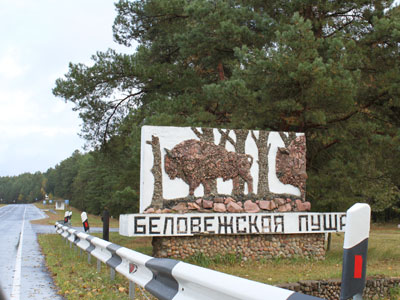
A roadsign with the park's name in Russian
In 1957 the status of Belovezhskaya Puscha was changed from reserve into a hunting forestry for the top-ranking hunters of the Communist party. A top-end governmental manor Viskuly was built to accommodate VIP visitors, respective hunting infrastructure was created (In 1991 the treaty on the creation of the Commonwealth of Independence State was signed in Viskuly Residence). Apart from this, roads, phone and power lines were built across Belovezhskaya Puscha, comfortable houses for the staff were constructed. The regime of secrecy kept the mass visitors away which contributed to the preservation of fauna and flora.
Apart from this, roads, phone and power lines were built across Belavezhskaya Puscha, comfortable houses for the staff were constructed. The regime of secrecy kept the mass visitors away which contributed to the preservation of fauna and flora. In 1991 the Council of Ministers of the Republic of Belarus reorganized the hunting forestry into the State National Park Belavezhskaya Puscha.
In 1992, a year after the collapse of the USSR, Belavezhskaya Puscha was included in the UNESCO World Heritage List and a year later it gained the status of a biosphere reserve. In 1997 the National Park Belavezhskaya Puscha was awarded with a diploma of the Council of Europe for the success in the wildlife preservation and in 1998 the park became a key ornithology area of international significance.
Nowadays Belavezhskaya Puscha is a large national park located in the territory of two states – Poland and Belarus. The Belarusian part of the reserve is over 150 thousand hectares large and it is located in Kamenets and Pruzhany Areas of Brest Region and Svislosh Area of Grodno Region of Belarus. The administration of the reserve is located in Kamenyuki Village.
INFRASTRUCTURE
Belavezhskaya Pushcha is one of the key Belarus tourist attractions that draws tens of thousands of tourists every year. In Belavezhskaya Pushcha there is a Wildlife Museum where visitors are told about the flora and fauna of the reserve. Also, there are three hotels, two guest houses in scenic locations with the total capacity of 16, sauna, bar and a restaurant where one can taste dishes of the Belarusian cuisine. The reserve features good sports infrastructure enabling visitors to take up different kinds of sport.
If you wish to include Belovezhskaya Puscha into your Belarus tour - please contact your Minsk private guide!
|
|
Questions are welcome!


Featured
Applying at their local Belarus Consulate, the citizens of migration-secure states (e.g. the USA, Canada, Japan and others) can obtain a short-term...
The form of application for a visa to Belarus has become digital and you can save and send it as a PDF file. It is only a 2-page document that is available...
Quite a number of things, as a matter of fact. Let’s examine a typical case from my travel agent’s past with a traveler landing in Minsk Airport (MSQ) and applying for a visa...
People, who want to travel to Belarus to see a friend, take care of the grave of a relative, take part in the court hearings, etc. need to apply for a private visa...
This article covers field family research in Belarus that in most cases comes after dealing with the State archives of Belarus and genealogical research.
A plastic card is a fine thing, no doubt, but there have been a number of cases when the ATM displayed ERROR, or required a PIN code...
While most tourists agree that Belarus is not the country for grand shopping, there are still some things that can be brought back as souvenirs...