About Belarus
Articles dedicated to Belarus history, Belarus politics, Belarus economy, Belarus culture and other issues and Belarus tourist destinations.Brest or Brisk - an ancient Belarusian town
HISTORY
Brest is the third oldest city in Belarus. Berestye (the city name probably comes from the name of local bush - beresta) was first mentioned in 1019 as a trade center and a fortress on the border with the Polish and Lithuanian lands. In the 12th century a wooden castle was built to fortify the town and a customs fee was collected from the transit merchants.
In the 14-16 centuries Berestye was one of the largest cities of the Grand Duchy of Lithuania (joined in 1319), its customs house was the most profitable in the country. The income of the city drew attention of different foreign powers - crusaders, tartars and many others. Numerous invasiouns destroyed Berestye for a number of times after which it was restored from scratch. In 1388 Jews came to the country from the west bringing their religious law, traditions and capitals into the new homeland. The decree by the Grand Duke Vitovt made them a free community subject to paying taxes and entitled to use their own judicial legislation. Later on in Brest (which they called Brisk) Jews elected their top authority - vaad - a convention of the most renowned rabbis that regulated every aspect of the community's life.
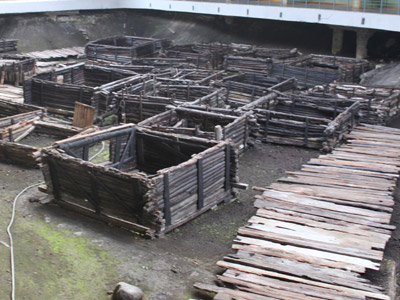
Ancient Brest of the 13 c, discovered in the 1970s
In 1390 the city, by then a major center of trade and crafts, got Magdeburg Right – the right for self-governance – the first among other Belarusian cities. In 1409 the joint strategy for the general battle with the Teutonic crusaders was worked out in Berestye by the Polish King Yagailo (Yagello) and the Grand Duke of Lithuania Vitovt (Witold).
In the 1550s Mikalai Radziwill Cherny established a printing house in Brest – the first one in Belarus. The 1566 inventory of the Brest county listed 744 houses in Brest (90 belonged to Jews).
In 1569 a Lublin Treaty was signed to unite the Polish Kingdom and the Great Duchy of Lithuania and the city got a new name - Brest-Litovski. The name Brest-Litovsk was adopted after the Lublin Union of 1569 to tell it from another Polish town – Brest Kuyavsky. Before that the city was called Berestye or Brest (Brzest), the latter presumably being a shortened Polish version of the old name.
In 1596 the Brest Union was signed in Berestye uniting Orthodox and Catholic churches into the Greek-Catholic Church that became immensely popular with the majority of the country’s population. In 1665 a mint was established in Berestye – the first one in Belarus.
By the end of the 15 century Berestye turned into a flourishing city with the population of over five thousand people. The city center was developed on an island where the citadel of the Brest Fortress can be found today. The tragedies then followed one another, starting with the 1648 Cossac uprising under Bogdan Khmelnitsky that resulted in a terrific wave of violence aimed at the Jews and Catholics.
Reporting from Brest Fortress. In June 1941 it took the first German blow and never surrendered. In late June 45th German infantry devision laid out their first cemetery in the Eastern Front...
Posted by Minsk Guide on Tuesday, 7 April 2015
The Swedish troops captured Brest-Litovsk twice – in 1657 and 1706 – and devastated it and in between Russian-Polish wars left the trail of devastation. It is only in the second half of the 18 century that the city started to experience economic revival. In 1770s a cloth manufactory was established in the city. In 1795 Brest-Litovsk with its population of 3500 people became a territory of the Russian Empire. The Jewish population like the Christians of the Grand Duchy had issues with integrating into the new country. Many privileges of the aristocrats were axed while Jews had to pay more taxes on different occasions. In 1812 French troops occupied the city for three times and their battles with the Russian army affected the city.
1804 edict of the Tsar gave the Jews certain rights and priviliges including the right to buy land in the countryside and make such households exempt from tax. At the same time following the decree from 1795 a few years later Jews were moved (sometimes by force) into towns. The relocation campaign stepped up in the mid 1820s. Jews made about 70 per cent of the town's population and by then their number increased to over 4000 people.
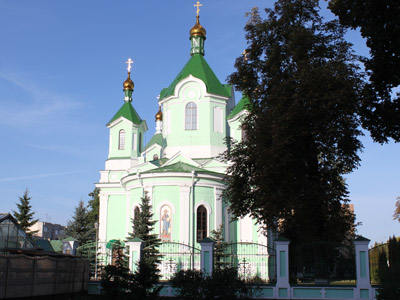
St. Simeon Orthodox Church in Brest, 1865
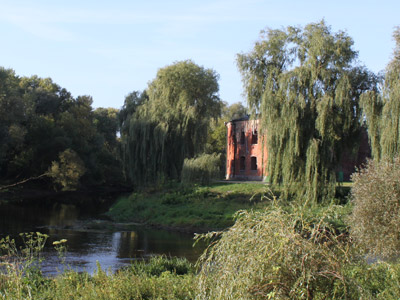
The ruined defences of the Brest Fortress, 2011
GET AROUND AND SEE
Since Brest was moved from its original location on the central island in the 1830s the present-day city offers historic sights that are 100-150 years old. These include the Russian Orthodox and Catholic churches, several buildings dating back to the tsar years, a number of museums and Polish streets of the 1920s.
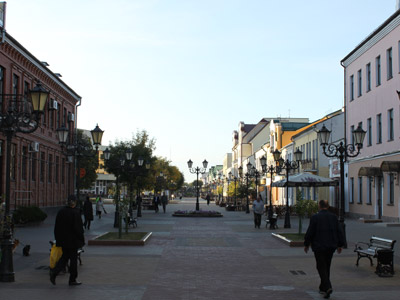
Sovetskaya pedestrian street in Central Brest
The Old Town of Brest is pretty small and is within a walking distance away from the railway and bus stations. So after checking into one of the central hotels – Pyat Kolets, Westa or any other you have every chance to reach the Brest Fortress memorial, Train Museum and the Museum of the Recovered Values on foot.
Sovetskaya Street, a short walk away from Gogolya or Lenina Street, is closed for the traffic and is a nice place to walk around at night with a good choice of cafes and restaurants.
Other sights worth a visit in Brest include the Orthodox Church of St. Simeon in Masherova Avenue, next door to Brest-Intourist Hotel, the Cathedral of the Exaltation of the Holy Cross in Lenina Street, the Brest Holy Resurrection Church in Moskovskaya Street and St. Nicholas Brethren Church in Mitskevicha Street not far from the Brest Bus Station.
Weather permitting you can pop into the Park of the 1st of May (laid out in 1906) and have a nice walk along the alleys. One of the Brest's good restaurants U Ozera is located deep in the park in the building that dates back to the early 20th century.
STAY AND EAT
The number of accommodation options in Brest is constantly growing. There are several budget hotels – Bug (2 Lenina Street), Molodezhnaya (6 Komsomolskaya Street), Start (5 Vtoraya Zavodskaya Street), Stroitel and Pyat Kolets, mid-range – Westa and Brest-Intourist and even a top-end four-star hotel – Hermitage.
There is a nice cheap café on the first floor of Brestsky Sports Complex, 9 Gogolya Street. In the Brest Fortress Memorial, to the left from the star entrance there is Citadel Café, but the price-tag down there is slightly higher. In Sovetskaya Street there are Pizza al Taglio and several other places (might be fully occupied in the evening) and in 29 Gogolya Street there is a top-end restaurant called Jules Verne – the right place for some celebration or a goodbye dinner.
Ancestral tour of Brest
|
|
Questions are welcome!


Featured
Applying at their local Belarus Consulate, the citizens of migration-secure states (e.g. the USA, Canada, Japan and others) can obtain a short-term...
The form of application for a visa to Belarus has become digital and you can save and send it as a PDF file. It is only a 2-page document that is available...
Quite a number of things, as a matter of fact. Let’s examine a typical case from my travel agent’s past with a traveler landing in Minsk Airport (MSQ) and applying for a visa...
People, who want to travel to Belarus to see a friend, take care of the grave of a relative, take part in the court hearings, etc. need to apply for a private visa...
This article covers field family research in Belarus that in most cases comes after dealing with the State archives of Belarus and genealogical research.
A plastic card is a fine thing, no doubt, but there have been a number of cases when the ATM displayed ERROR, or required a PIN code...
While most tourists agree that Belarus is not the country for grand shopping, there are still some things that can be brought back as souvenirs...