Articles dedicated to Belarus history, Belarus politics, Belarus economy, Belarus culture and other issues and Belarus tourist destinations.
Grodno - sightseeing splendour of Belarus
updated on 20/06/2011
The archaeological findings suggest that the city of Grodno was founded in the late 10 century on the Castle Mount. It appears that the Slavic tribes settled at the confluence of the Gorodnichanka and the Neman River escaping from the forcible promotion of the Christianity. The city was conveniently established on the way from the Baltic coast to the Black Sea.
In 1128 Grodno was mentioned in the Chronicles as a center of a small principality, at that point an ally of Kiev. The city was of top interest to the neighbours and constant wars were destroying it once in a while. The Crusaders alone captured Grodno five times in the 1200s.
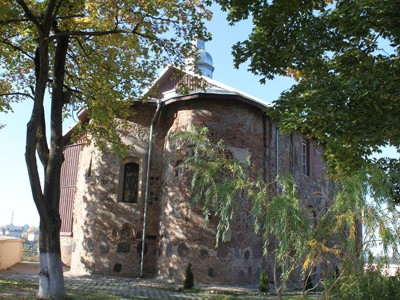
St. Boris and Gleb Church - the oldest operational church in Belarus, 1180s.
Throughout its history Grodno was a part of different states: the Grand Duchy of Lithuania, Rech Pospolitaya and the Russian Empire and its history in many ways is a mirror reflection of the history of Eastern Europe.
In 12-13 centuries Goroden evolved on the right bank of the Neman River and its convenient geographical location contributed to its evolution into a major trade and crafts center. The oldest surviving building of Grodno is Boris and Gleb (Kolozha) Church. The oldest operational Orthodox Church in Belarus and a UNESCO candidate was built on a bank of the Neman River in the 1180s.
In the 1270s Goroden was included in the Grand Duchy of Lithuania to become a major border fortress in the west. Davyd Gorodensky, the local prince and a talented military commander made a great contribution fighting the Teutonic invaders in this period.
In 1376 the Grand Duke Vitovt established his residence in Goroden. It therefore became the second capital of the Grand Duchy of Lithuania and in 1391 it got partial Magdeburgh Right. In 1410 a military unit from Grodno took part in the battle at Grunwald, now Poland, that resulted in a shattering defeat of the crusaders.
In the 1380 the Jewish community of Grodno was established for the first time. It was to become one out of three most affluent communities in the country along with those in Pinsk and Brest. After the return to the country in the 1500s (following 1495 eviction of Jews) their share in the city's taxation was set at 17 per cent by the queen, rights extended and confirmed. At different stages Jews made up to 85 per cent of the population (1816). The historic Jewish district in Grodno with the cemetery and synagogue is still there.
The construction of the city buildings on the left bank of the Neman started in the second half of the 15 century, but that was just a minor development. After the city got the full Magdeburg Right in 1444 the city authorities started building a town hall to host sessions of the city council. Grodno got its coat of arms in 1540 – a running deer with a cross.
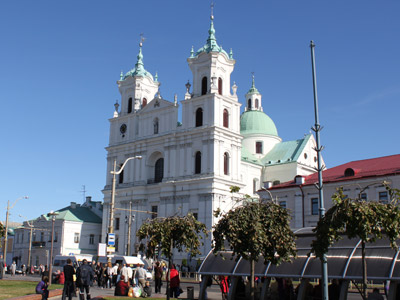
The country's first pharmacy that was established in Grodno in 1677 next to the parish Cathedral of St. Francis Xavier in Market Square (Sovetskaya Square) still functions today and features the only pharmacy museum in Belarus.
As a result of the Lublin Treaty of 1569 Grodno became a city of Rech Pospolitaya and a few years later – a royal residence. The residence could compete with the best European capitals of the time in its grandeur and luxury but in the mid 17 century the development of Grodno was dwarfed by the Russian-Polish war.
The situation was exacerbated by the Northern War of the early 18th century. The session of the parliament of Rech Pospolitaya at which the partition of the country was approved of took part in Grodno in 1793.
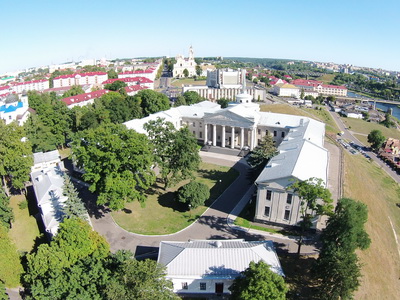
New Castle in Grodno, 1742
In the mid 18th century 20 manufactories were established in Grodno and nearby areas including cloth, furniture, tobacco and armament manufactories. In the 1765-1780 a very special man was in charge of Grodno - Antony Tyzengauz. He tried to reform the society and the economy by building a new area of Grodno - Gorodnitsa (now Lenin Square). Several dozen buildings were built for the project 8 of which survive to the date. Tyzengauz launched the Botanical Garden, Medical School, Theatre and a number of enterprises where European specialists were contracted.
St. Xavier Parish Cathedral in Grodno, Belarus
In the late 19 – early 20 century Grodno was a fast-developing city mainly due to the construction of a railroad from St. Petersburg to Warsaw in 1862. According to the first all-Russian census of 1897 about 47 000 people resided in Grodno.
At the beginning of the First World War Grodno was at the frontline and was soon occupied by the Germans. In 1919 the Poles took over the city replacing the Germans and for the next two decades Grodno as well as the rest of Western Belarus became a Polish territory. After the reunification of Belarus in September 1939 Grodno became a regional center of Soviet Belarus.
The Great Patriotic War that started on the 22 June 1941 claimed lives of over 50 000 Grodno residents including all Jewish population and intellectual elite. The liberation day of Grodno came on 16 July 1944 ending three years of the Nazi occupation. The post-war efforts of the city population restored Grodno that had not been severely damaged in the course of the occupation.
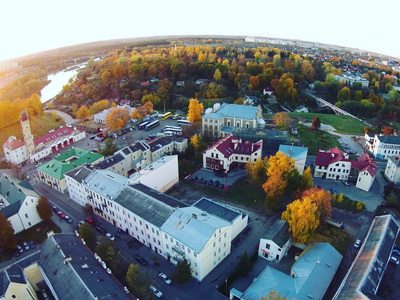
Grodno Choral Synaggue and the area
Today it is a thriving industrial and cultural center in Western Belarus. Many monuments of architecture have been restored and the city by right enjoys the status of one of the top tourist destinations in Belarus.
Today Grodno is improving its catering. A nice place can be found at the Neman embankment in a 19th century mansion - Korchma u Prichala - just down the hill from the castle. The third place can be found near the puppet theatre a step away from Lenina Square in 1 Dzerzhinskaya Street - Stary Lyamus.
If you wish to take a city tour of Grodno, you might consider my private tour. Such a tour might be a part of a Belarus package tour tailored on your request or a part of your ancestral tour to Belarus.
The form of application for a visa to Belarus has become digital and you can save and send it as a PDF file. It is only a 2-page document that is available...
Quite a number of things, as a matter of fact. Let’s examine a typical case from my travel agent’s past with a traveler landing in Minsk Airport (MSQ) and applying for a visa...
People, who want to travel to Belarus to see a friend, take care of the grave of a relative, take part in the court hearings, etc. need to apply for a private visa...
This article covers field family research in Belarus that in most cases comes after dealing with the State archives of Belarus and genealogical research.