About Belarus
Articles dedicated to Belarus history, Belarus politics, Belarus economy, Belarus culture and other issues and Belarus tourist destinations.The history of Slonim, Belarus
The name Slonim is explained by several theories - some researchers believe that constant finds of mammoth bones (elephant is slon in Russian) are the reason for that and some - that the roofs were covered with straw (soloma). It seems that the most credible version today is that the city name originates from uslon - outside city defenses.
Once Lev Sapega became the head of Slonim county in the early 1600s its infrastructure started to improve. He had bridges repaired, roads built, solid guest houses established - everything to make an impression on the delegates to the regional parliament sessions of the Grand Duchy of Lithuania who convened in Slonim.

The churches of Slonim today
The wars of the mid-17th and early 18th centuries inflicted terrific damage on Slonim. After a period of growth it went into a deep decline which lasted for over a century. The years when Mikhal Kazimir Oginsky was in charge in the 1770s saw a return to the old ways. Oginsky had a palace built, shops open, various manufactories established, masonries constructed to accommodate the specialists. The town's sewage system was launched under his rule.
In 1795 Slonim became a part of the Russian Empire, a center of a county in Grodno gubernia. In 1880 Baranovichy - Warsaw railroad passed through Slonim followed by Baranovichy - Belostok several years later.
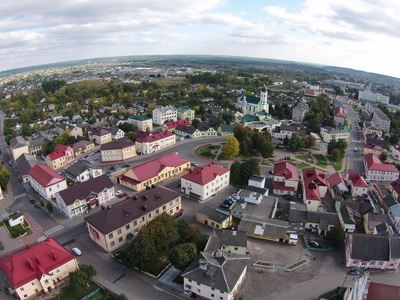
The Old Town of Slonim today
Major landowners counts Puslovskies who ran Slonim at the turn of the 20th century took considerable efforts to boost the city's potential: manufactories for copper, timber and carpets were founded in Albertin suburb along with a cloth factory.
In the first half of 1915 the WWI frontline reached Slonim with action devastating the city badly. In 1919 the Soviet power was briefly established in Slonim but after the Riga Peace Treaty it passed to Poland. The Soviets didn't return until 1939.
The Great Patriotic war that started in June 1941 claimed enorous death toll in Slonim - about 45 000 people were killed. Petralevichy mound was an execution ground to 10 000 civilians, Chepelev fields - 30 000. Slonim was not liberated until July 1944.
Jews of Slonim
When Slonim became a ground for the Duchy parliament sessions the significance of the city and its Jewish community increased sharply. In 1642 a huge stone Baroque synagogue was built. In the course of the Russian-Polish wars in 1660 Slonim Jews suffered from the violence inflicted by the Russian army.
The Jews who lived in the early 18th century were engaged in timber and wheat trade, brewing and various crafts. Counts Oginskis attracted craftsmen and merchants to live in the city, Jews amongst others. By 1766 the Jewish population of Slonim and the area exceeded 1100 people.
A Russian city since 1795, Slonim saw its Jewish population increasing rapidly: in 1847 it scored 5 700 and 1897 - 11 500 which made up 72 per cent of the city population. The infamous Temporary Rules introduced in 1882 forced many Jews out of Slonim villages.
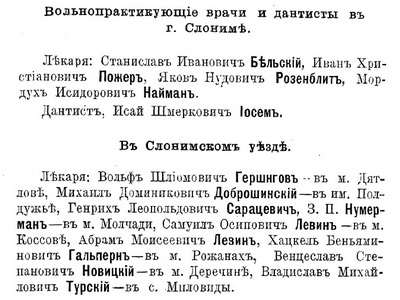
1902 listing of Slonim doctors and dentists: Stanislav Bielski, Yakov Rosenblit, Mordukh Naiman, Isay Yosem
At the turn of the 20th century the Jews of Slonim were engaged in trade (furs, wheat and timber), logistics, woodworking industry, brick production and owned a number of steam mills. The first cloth factory in Slonim was established by a Jewish businessman in 1826 - out of its 35 employees 20 were Jews.
By the late 1800s Jewish business opened up around 30 small factories. In the early 20th century the Jews of Slonim ran 7 synagogues, several prayer houses and kheders, a Talmud Tora school and four private Jewish schools.
In the mid-19th century Abraham ben Itshak Weinberg resided in Slonim. He established a new chasidic stream and the Slonim tsaddik dynasty which soon took over Slonim yeshivah - one of the oldest and most influential in Belarus.
In the "Polish times" between 1921 and 1939 the Jewish community of Slonim grew and numbered over 8 600 people in 1931. Several political and educational establishments functioned in the city. Zionists were in charge of the community.
September 1939 saw Slonim becoming a Soviet city. Jewish population increased sharply because of the refugees from Nazi-occupied Poland. The Soviet authorities started repressions against the Zionists and Bund activists closing down Jewish schools and synagogues as they progressed.
The Nazi occupied Slonim on 25 June 1941. A month later the Nazi arrested 1200 Jewish men and shot them in the outskirts of the city. In August 1941 the Nazi forced the Jews of Slonim and neighbor villages into a ghetto. About 9 000 inmates were destroyed on 14 November 1941, 10 000 more - in summer 1942.
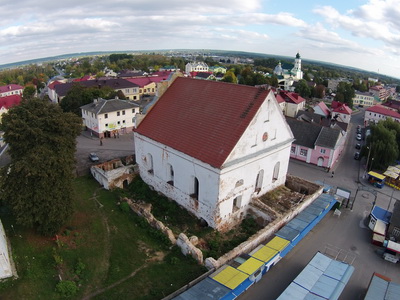
Old Slonim Synagogue falling into pieces...
During the second Aktion the Jewish youths offered an armed resistance to the Nazis and their Belarusian and Lithuanian collaborators. About 500 people managed to fight their way into the partisan units. The 300 survivors were destroyed in December 1942.
Less than a hundred Jews returned to Slonim upon its liberation in July 1944 but the community was never restored. In 1989 95 Jews resided in the city. Several synagogue buildings can be found in Slonim today including the Big Synagogue of 1642. It was built of bricks and became the dominant of the square. The walls are two meters thick and the elongated windows resemble loopholes. The interior features luxurious plastering and wall frescoes. The building of Slonim synagogue is disused today and is falling into decay.
If you wish to take an ancestry tour to Slonim or the area, do not hesitate to contact your private guide in Minsk!
|
|
Questions are welcome!


Featured
Applying at their local Belarus Consulate, the citizens of migration-secure states (e.g. the USA, Canada, Japan and others) can obtain a short-term...
The form of application for a visa to Belarus has become digital and you can save and send it as a PDF file. It is only a 2-page document that is available...
Quite a number of things, as a matter of fact. Let’s examine a typical case from my travel agent’s past with a traveler landing in Minsk Airport (MSQ) and applying for a visa...
People, who want to travel to Belarus to see a friend, take care of the grave of a relative, take part in the court hearings, etc. need to apply for a private visa...
This article covers field family research in Belarus that in most cases comes after dealing with the State archives of Belarus and genealogical research.
A plastic card is a fine thing, no doubt, but there have been a number of cases when the ATM displayed ERROR, or required a PIN code...
While most tourists agree that Belarus is not the country for grand shopping, there are still some things that can be brought back as souvenirs...