About Belarus
Articles dedicated to Belarus history, Belarus politics, Belarus economy, Belarus culture and other issues and Belarus tourist destinations.Minsk - history and present days
HISTORY
Minsk was founded about nine hundred years ago as a border fortress of Polotsk Principality – one of the first states in the modern territory of Belarus. It was first mentioned in the chronicles in the description of a bloody battle of 1067 that resulted in complete devastation of the town and its castle. In the 13th century Polotsk Principality disappeared from the political scene of Eastern Europe giving way to the new state – the Great Duchy of Lithuania. In this state Minsk was the third largest city after Wilno (Vilnius) and Grodno. The city got the Magdeburg right that enabled the residents to elect a city council that was in charge of taxation, trade and city development, contributing to the growth of the city.
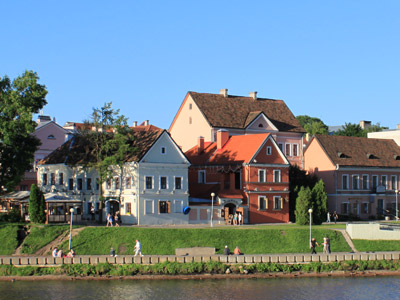
The 19th-century-style Trinity Suburb in Minsk, 2010
After Belarus became North-Western province of the Russian Empire, the development of Minsk proceeded according to the sample Russian plans. Curved narrow streets with log houses were gradually replaced with stone buildings arranged in neat square blocks. However, the city growth picked up pace only in the 1870s after the new railroads that connected Moscow and Brest, Latvia and Ukraine crossed in Minsk.
Since the time it was first mentioned, Minsk was rebuilt and destroyed for quite a number of times in the course of wars, fires, rebellions and occupation regimes, the most devastating of these being the Nazi occupation 1941-1944.
The WWII left the city of Minsk in ruins. According to the Nazi reports, it was flattened to the ground by 82 per cent in the first weeks of the war.
Some elderly people recall that soon after the war there was hardly anything beside collapsed roofs of the buildings and debris and ashes of the smaller ones. The plan to leave the ruins as they were and to relocate the capital to Mogilev was never fulfilled. Enormous efforts of the local residents aided by the help from the sister socialist republics and international donors restored the city of Minsk.
The Soviet architects designed Minsk as a model Soviet city, the western gates into the whole of the USSR. Most of the city can boast of wide new roads and pedestrian zones, squares, parks and public gardens. The Soviet-style housing and public buildings are predominant, but many newly-built modern office buildings and residential blocks can be seen in the city center and closer to the ring road where construction is in progress. Minsk is home to over 1.8m people.
So today, when the Soviet Union is well in the past we are living in the city of Minsk, a city with a very long history and a rather modern infrastructure that is constantly upgraded in order to meet the needs of the urban population and the inbound tourists.
GET IN
Being the center of Minsk region Minsk can be reached by air and land. Trains from Berlin to Moscow pass through Belarus, there is also a train from Kiev to Minsk. Since Vilnius is closer to Minsk than Grodno (the center of Grodno region in the west of Belarus) you can take either train or bus to travel between these two capitals. You can take a flight via Warsaw, Prague or Berlin to land in MSQ Minsk International Airport, blessedly Belarus is now available for 30 days without a visa to the citizens of over 70 countries.
GET AROUND
If you are on a budget trip, Minsk metro and the land public transport are the best way for you to get from one sight to another. Most sights are scattered around central Minsk and in good weather you can cover them during a few hours’ walk. Taxi drivers who meet Minsk tourists at the bus and railway stations will gladly overcharge them when trying to negotiate the drive costs. Make sure that your taxi features yellow number plate (licensed vehicle) and a meter.
In summary, the three days I spent in Minsk were interesting; above all, the city was clean and the people were *always* friendly. I frequently had to ask (well, point at my LP guidebook) for directions, and everybody was willing to help. Even the stern lady selling international train tickets nearly managed a smile! In fact, upon arrival late on the Sunday night, a Minsk doctor asked (told) her husband to give me a lift to the hostel - this was appreciated. Interestingly, I felt safe whenever I was out; I tended to stay in the centre, venturing between the station and the river bank. I was sometimes the object of curiousity (I did not see anyone else who appeared to be a tourist), although in the snow I looked as cold as everybody else. Andy Wood, UK.
SEE AND DO
Download a free PDF guide on Minsk sightseeing.
Minsk Top Sights
|
|
Questions are welcome!


Featured
Applying at their local Belarus Consulate, the citizens of migration-secure states (e.g. the USA, Canada, Japan and others) can obtain a short-term...
The form of application for a visa to Belarus has become digital and you can save and send it as a PDF file. It is only a 2-page document that is available...
Quite a number of things, as a matter of fact. Let’s examine a typical case from my travel agent’s past with a traveler landing in Minsk Airport (MSQ) and applying for a visa...
People, who want to travel to Belarus to see a friend, take care of the grave of a relative, take part in the court hearings, etc. need to apply for a private visa...
This article covers field family research in Belarus that in most cases comes after dealing with the State archives of Belarus and genealogical research.
A plastic card is a fine thing, no doubt, but there have been a number of cases when the ATM displayed ERROR, or required a PIN code...
While most tourists agree that Belarus is not the country for grand shopping, there are still some things that can be brought back as souvenirs...