About Belarus
Articles dedicated to Belarus history, Belarus politics, Belarus economy, Belarus culture and other issues and Belarus tourist destinations.Mogilev - the Grave of the Lion...
Mogilev dates back to around 9 century AD according to the archaeological evidence. Some findings suggest that in the middle of the 13 century it was destroyed by Mongol-Tartars. At that time Mogilev was most likely a center of a feudal principality and had a fortress. Some tie the origin of its name to a novel legend about a villain Lew on whose grave the city emerged to be called Mogilev (Lew’s grave). Historians suggest that it was a property of some prince called Strong Lew (Mightly Lew or Mogilev).
In the 14 century Mogilev principality becomes a part of the Grand Duchy of Lithuania. It changed owners throughout the century and soon became a center of Mogilev economic area. Judging by the terms used in the written sources the city grew rapidly and soon a new wooden fortress was built in it surrounded with a rampart.
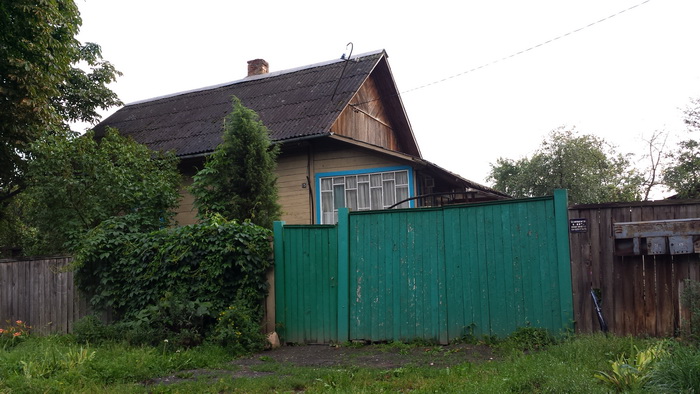
Mogilev dwelling house, peculiar eastern Belarusian architecture
In the early 16 century Mogilev was the largest Belarusian city on the Dnieper River. In 1577 the city had 1261 house, about 6500 residents; in 1604 over 15000 residents lived in 2211 houses. A century later Mogilev became one of the major centers of trade and crafts in Belarus and later on – of the whole Grand Duchy of Lithuania. Over forty per cent of the population was made up of craftsmen – blacksmiths’, jewelers, painters, joiners, leatherworkers, brewers, butchers, etc.
In the late 16 century about 40 different crafts were registered in Mogilev, in the mid 17 century – up to 80. Mogilev craftsmen had high ratings not just in Belarus but also in the foreign countries. Most of the craftsmen were united into guilds. Mostly manufactories produced small amounts of items that were sold through multiple small stores they owned.
In 1577 Mogilev numbered 157 shops, in the early 17 century – around 400. Mogilev city market had shopping rows for boots, metal items, fish, meet, fabrics, salt, bakery, pottery and such important things as the weighing room, tavern and warehouses. Merchants were mostly involved in trade – they made up to 30 per cent of the city population. Favourbale geographical location of Mogilev upon the Dnieper ensured connection with foreign trade centers – routes to the Baltic Sea and Ukraine crossed here.
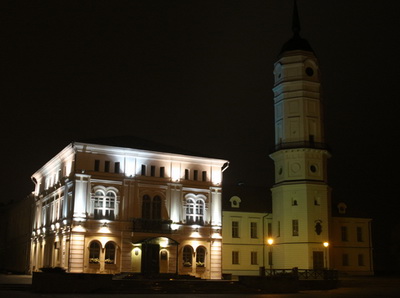
Mogilev town hall (rebuilt in 2008) and the Magistrate office building (19th century)
Social composition and standards of living of Mogilev residents were not uniform. Landlords and clergymen were the richest and were positioned considerably better than other city residents. Middle class consisted of the higher middle class - major merchants and rich craftsmen and lower middle class – average merchants and small-scale craftsmen who paid most of the city taxes and fees imposed on the city. A sizeable proportion of the Mogilev residents were pretty poor taking odd jobs or begging to survive.
In 1561 Mogilev became a separate administrative unit with its own government. A few years later the city became a part of Rech Pospolitaya. In 1577 Mogilev got Magdeburg right and the magistrate was elected. Mogilev could also host two fairs a year and build a town hall.
In 1580 Mogilev was pillaged by the Russian army that torched most of the houses. In the 1595 the rioting Cossack troops of S.Nalivaiko captured the city for two weeks. They were evicted from the area but they left Mogilev leaving the wake of destruction behind.
Further decline of the economy came after the 1648 uprising in Ukraine. The Russian-Polish wars that followed saw Mogilev surrendering to the Russian army though a couple of years later the residents put up a riot against Muscovites and evicted them.
The Northern War between the Russian Empire and Sweden in the 1700s exacerbated the situation in the country because it became the arena for the action. Enemy armies crossed Mogilev several times and both the presence of the Swedish and Russian armies proved to be extremely damaging to the city and area.
At the village of Lesnaya near Mogilev the key battle of the war took place with the Russian army achieving victory over the Swedes. Locals still call the mounds in the area “Swedish graves”.
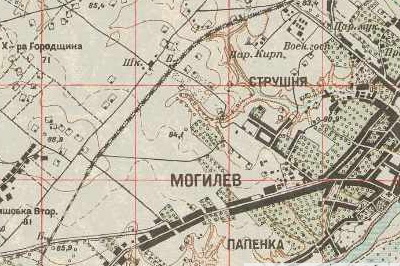
Mogilev map of the 19th century
The Russian-French war in 1812 interrupted comparatively peaceful period of the late 18th century. Once the city had been abandoned by the Russian administration the French military authorities began to confiscate the last food reserves of the locals. Mogilev peasants were particularly active in the resistance activities.
By the 1860s Mogilev turned into a major Belarusian city with every third building in town built of stone. 2500 craftsmen lived there, 189 enterprises were registered employing 1000 people. One of the first flour mills was built in 1841 equipped with a steam engine and operated by many hired hands.
Several public and private schools functioned in Mogilev in the 1830s, the first public library was opened in 1833 and a newspaper was issued a few years later.
National uprising in 1863-1864 in Poland and Belarus echoed in Mogilev area with many locals joining the opposition.
The abolition of serfdom in 1861 sped up development of Mogilev, revived industry and trade. In 1885 there were 124 enterprises employing 270 people, in 1900 – 220 (790 employees). At the turn of the centuries there were three loan societies, three printing houses and mechanical workshops. In 1888 the building of the theatre was built. In 1897 Mogilev had 43119 residents of which 47 per cent were literate. Democratic societies and parties were becoming more and more popular among the workers and students.
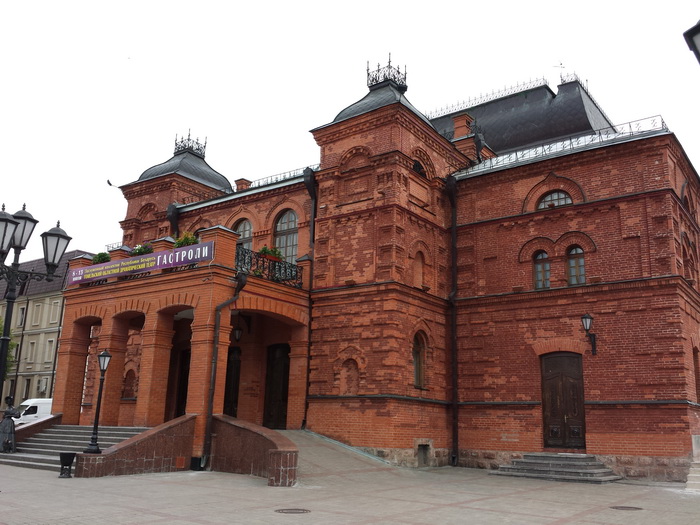 Mogilev theatre building
The economic crisis of the early 1900s saw the closure of many businesses. In 1902 a railway connecting St.-Petersburg and Odessa crossed Mogilev, followed by the introduction of horse-drawn carriages. In 1913 Mogilev numbered 69700 residents.
During the First World War the headquarters of the last Russian Emperor Nicholas II was located in Mogilev – a special side-track was built for his carriage at the train station.
In 1919 a number of factories was working and a year later after capital renovation several more were launched. Throughout the next decade private enterprises and shops were being turned into state property – by 1923 state-run factories produced 70 per cent of all products in the city. The Soviets were remodeling the society to their liking and to facilitate the process opened libraries, clubs and schools for mandatory education. Mogilev only became the center of its own region in 1938.
On 1 January 1940 Mogilev had 210 enterprises employing 13000 people. Population increased dramatically: in 1939 – 99 400, in 1941 – 120 000. Before the war Mogilev had 12 clubs, 2 movie theatres, 13 libraries, area history museum a drama theatre.
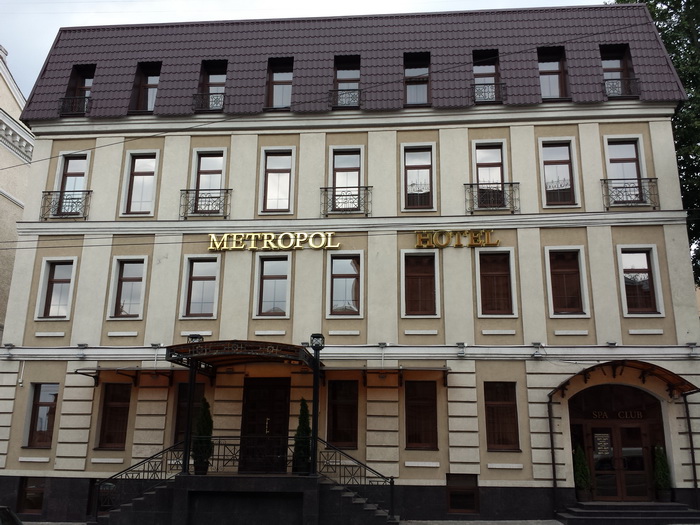 Mogilev hotel building, 19 century
In the 1930s Communist authorities of the Eastern Belarus (then BSSR) played with the idea of shifting the capital to Mogilev – the House of Soviets was erected and a number of other pretty solid buildings. Major finance was allocated to the city development but the Great Patriotic War ruined all the plans. Mogilev never became a capital though for a while the idea existed after the war.
The Great Patriotic War saw Mogilev defence efforts in place between 3 and 26 July 1941. These cost the Nazi many men and days and altered their invasion schedule. Valuable experience of this remarkable struggle was later employed at Stalingrad by the Red Army. During the occupation of Mogilev about 70 000 Soviet citizens got killed, about 30 000 Mogilev residents were taken to Germany as forced labour. On the liberation day the population of the city was under 10000. About half of the buildings survived, most of the factories flattened, a lot of equipment pillaged by the Nazi.
After the liberation the residents got down to rebuilding the industrial and residential infrastructure. People volunteered to extend the working days and worked on Saturdays and Sundays for free.
The first bus was launched in 1946, the first woodworking and metalworking enterprises were launched as well. Within the first post-war five-year program most factories were rebuild to make the core of the city’s economy, their output increased ten times. Mogilev turned into a city of machine building, metal and chemical industries.
The city’s population increased and respectively its area and today Mogilev has a 400000-strong population and is the fourth largest city in Belarus in this respect.
Mogilev sights include: the walking sections of the Leninskaya Street with its monuments of architecture ranging from 17 till 19 century, the railway station, Catholic and Russian Orthodox monasteries, Mogilev Drama Theatre, and, for those in interested in Jewish history of Mogilev, three old synagogue buildings and Mogilev Jewish cemetery. If you would like to take Mogilev city tour - do not hesitate to contact me!
|
|
Questions are welcome!


Featured
Applying at their local Belarus Consulate, the citizens of migration-secure states (e.g. the USA, Canada, Japan and others) can obtain a short-term...
The form of application for a visa to Belarus has become digital and you can save and send it as a PDF file. It is only a 2-page document that is available...
Quite a number of things, as a matter of fact. Let’s examine a typical case from my travel agent’s past with a traveler landing in Minsk Airport (MSQ) and applying for a visa...
People, who want to travel to Belarus to see a friend, take care of the grave of a relative, take part in the court hearings, etc. need to apply for a private visa...
This article covers field family research in Belarus that in most cases comes after dealing with the State archives of Belarus and genealogical research.
A plastic card is a fine thing, no doubt, but there have been a number of cases when the ATM displayed ERROR, or required a PIN code...
While most tourists agree that Belarus is not the country for grand shopping, there are still some things that can be brought back as souvenirs...