About Belarus
Articles dedicated to Belarus history, Belarus politics, Belarus economy, Belarus culture and other issues and Belarus tourist destinations.Motol, the birthplace of Chaim Weizmann
In the ancient times when people started settling along the banks of the southern rivers in today’s Belarus their little villages mostly profited from farming and fishing. One of these villages on the Yaselda River is Motol, situated on the regional and local trade routes, with major towns nearby – Ivanovo, Logishyn, Pinsk. Motol today is a small town (or a huge village) located 300 km south of Minsk in Belarus.
According to one of the legends explaining the origin of the town, a Jew called Mottl established a tavern at the intersection of trade routes and around that a town was built subsequently. According to the other version, local butterflies "motyl" used as bait by fishermen were the reason to call it that way. Motol – is the birthplace of Chaim Weizman who liked to introduce himself as “a Jew from Motol shtettl”.
Motol was first mentioned in the metrics of the Grand Duchy of Lithuania in 1422 with 14-strong population. It was a private property of a Pinsk prince. Local peasants lived off farming, beehiving, fishing and hunting, paying taxes to the land owner.
Later Motol passed to the Duchess of Lithuania and Queen of Poland Bona Sforza. The latter apparently relocated some Italian craftsmen into the town which explains many Italian-sounding surnames of today’s residents. Motol became a local center of trade and crafts after getting Magdeburg right and its fairs drew visitors from all nearby settlements.
Multiple craftsmen – weavers, stovemakers, tailors, blacksmiths – lived along the main street of Motol. Other land lots belonged to peasants. By the way, traditionally, Motol didn’t have street names. Parts of it were named based on the welfare of its residents or some peculiar feature of that neighborhood: Vygon, Luka, Korzhyuka, Turubel’. Locals were fishing and hunting without any special permits.
In the 17-18 centuries Motol was a locality center in Brest area. After Belarus was taken over by the Russian Empire and Grodno Gubernia was established Motol was a center of Kobrin Uezd (county).
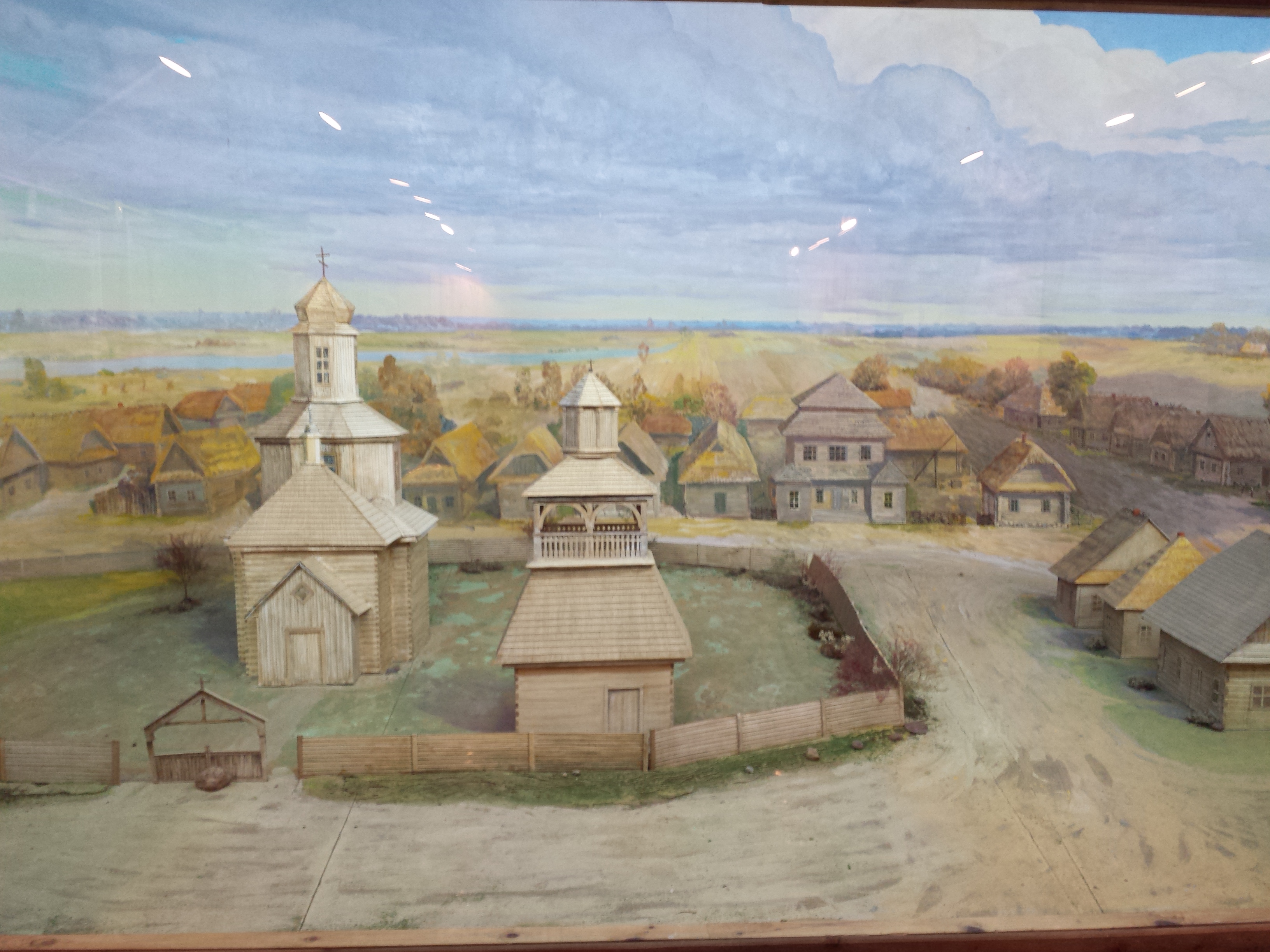
Museum exhibition recreates Jewish street in Motol behind the old church
The 1648 uprising of the Cossacks followed by the Russian-Polish war left the area in ashes though Motol remained unhampered by action. And though it was burnt in 1706 by the Swedes, Motol was rebuilt a few years later. Economic crisis resulted in the country’s general decadence and soon today’s Belarus along with Motol was taken over by Russia. An inventory of 1798 describing Motol in detail has survived. According to this document, it featured 3 noble households, 11 Jewish households, 113 households owned by the city residents and 15 - by peasants. There were 267 (18 Jews) men and 307 (25 Jews) women.
Residents of Motol belonged to the state and therefore were spared humiliating by local landlords. But their land lots were tiny and even to make hay for the winter one had to ask a permission from a landlord to use his meadow and pay one third of the harvest. Until 1861 no Motol girl married someone from another village – level of living there was much lower.
Many Motol men were contracted by the merchants to ship timber down the Pripyat River. Those who had a horse started working in logistics transporting merchandise as far as Moscow and Warsaw. Their way of life shaped their mindset. Researchers pointed out that residents of Motol were optimistic, independent and outgoing.
Jews were first mentioned in Motol in 1562 – Favim Yeskovich complained about poor profits of the customs rental. Papers of the 17 century describe Jews as permanent residents of Motol. In 1562 a complaint by a Russian Orthodox priest was filed for having being beaten up by the Motol Jews (they were building a house on Sunday and he voiced his concerns). In the 19 century Jews often made a significant group of the town’s population – in 1806 there were 152 Jews and in 1847 – 222. In 1885 out of 2194 Motol residents 404 were Jewish.
The town featured a stone church, wooden chapel, two Jewish prayer schools, a public school, the area authority office and two wheat storages. There were also two candle factories, a sawmill, three forges and a horse-powered mill.
With the serfdom abolished new factories were built and new businesses were established. Brest – Pinsk railway was under construction including a train station 20 kilometers away from Motol which gave employment to a lot of residents. First melioration attempts were undertaken in the 1870s.
In the 19th century a typical village house of Motol included a lobby, a storeroom and a living room. Development of capitalism saw to a change in the layout of richer houses - they were built larger, stoves had a chimney. Pine tree and oak were main construction material. High humidity and unstable sand soil required a good foundation, but rocks were in short supply. Houses were covered with straw or shingles made of asp or fir-tree. The big stove made the center of the house and was used for cooking and drying clothing. Living room was not just for sleeping – they cooked and ate food and worked here. And surely everyone tried to have his own well. A century later all these things are still there in a peasant house of Motol, because the way of life of a peasant hasn’t changed much.
Land was in short supply, too, so that forced locals rent it from the landlords in Molodovo and Zaozerye paying two thirds of the harvest. Fields were extensively fertilized and gave good harvests. If one wasn’t lazy, forests and lakes were used as additional food sources – they were picking mushrooms and berries, fished and kept beehives. Living so close to nature people were superstitious and religious.
The church book of 1871 lists 249 households in Motol. 2249 persons lived here, about 10 shops owned by the Jews operated.
There was a tavern and 16 shops. In 1896 there were 654 dwelling houses in Motol. According to 1897 All-Russian census out of 4297 residents in Motol 1354 were Jews. Tax forms of Motol mention such families as: Gottlib, Pulik, Chizh, Grushevsky, Fishman, Epstein, Gozman, Minz, Stupak, Belitsky.
Chaim Weizman was born in 1874 – his father Ezer came to Motol to study Tora. Chaim was the third child in the family out of fifteen in total. His basic education was provided at home after which he went to Pinsk where he attended the gymnasium. Upon his graduation the whole family moved to Pinsk.
Flying over Motol (known since 1422), Southern Belarus - the birthplace of Chaim Weizmann, the first President of Israel...
Posted by Minsk Guide on Tuesday, 8 September 2015
Since Motol residents were quite poor and land was scarce – best lots had been purchased by well-off people – they were frequently heading for the USA or South America to earn money.
In 1914 there were 3926 men and 3836 women in Motol. 7700 out of 9700 area residents at this point were Russian Orthodox. Between 1915 and 1918 it was occupied by German troops, later by the Polish army. Both parties made a good use of the area’s natural resources. The war badly affected the town with some people escaping to the east and some dying in action or from deceases.
Since 1921 and until 1939 Motol was a Polish territory. In 1921 around 4300 people lived in Motol, 25 per cent were Jewish.
From 1939 and on Motol was in Belarusian soviet republic and made a township in Ivanovo, Pinsk district with 871 households and over 4200 residents.
Turf was discovered nearby in 1940. They had a steam mill, leather workshops, sparkling water production, 2 fishing artels that employed 100 fishermen, a library, a post office and two primary schools, one of them was Jewish.
During the Nazi occupation Motol became a part of Ukraine District. From August on in 1941 Jewish population was being exterminated.
According to an lady, in early August 1941 (presumably 2 August – Russian Orthodox Ilia Day) the Nazi forced the Jewish population of Motol into the market square. They separated men and telling them about relocation to a labor site convoyed them towards Osovnitsa Village and executed next to the pre-arranged trenches. The lady – a 4-year girl at the time – witnessed them being escorted away singing their songs and crying. In a few moments shots were heard. Regrettably enough she pointed out, the Jews weren’t yet behind the horizon when some of the Motol locals raced each other to grab the best possessions that remained unattended.
Women and kids and elderly spent a night and were executed on the next day in the area called Gai south off Motol. The 2000-strong population of Motol was almost completely destroyed.
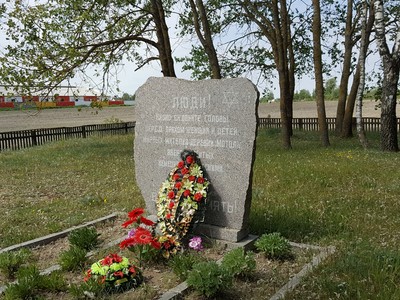
A memorial to the Jews of Motol by Osovnitsa Village
Some of the younger Jews managed to hide in the local vegetable gardens and in spite of repeated actions by the Nazi managed to survive and later visited the native sites.
Forced deportations of the locals to Germany were in place to use them as labor force. One of the operations took place in July 1943. Soon after that partisans captured a vast territory including Motol, evicting or destroying the garrison. The Nazi carried out a punitive operation which resulted in the destruction of central Motol in March 1944.
The other execution ground was located by the Gai forest on the Motol-Kalily road. Estimates suggest that about 3000 civilians were shot or buried alive by the Nazi. Several mass graves were discovered at the cemetery of Motol.
Before the war in Motol there were 1462 households, 7960 dwellers, while after the liberation in 1946 about 3000 people lived in Motol.
You travel to Motol easily if Pinsk is in your itinerary - the two are only 65 km apart. If you wish to take a tour to Motol, please don't hesitate to contact your private Minsk guide.
Flying over Motol
|
|
Questions are welcome!


Featured
Applying at their local Belarus Consulate, the citizens of migration-secure states (e.g. the USA, Canada, Japan and others) can obtain a short-term...
The form of application for a visa to Belarus has become digital and you can save and send it as a PDF file. It is only a 2-page document that is available...
Quite a number of things, as a matter of fact. Let’s examine a typical case from my travel agent’s past with a traveler landing in Minsk Airport (MSQ) and applying for a visa...
People, who want to travel to Belarus to see a friend, take care of the grave of a relative, take part in the court hearings, etc. need to apply for a private visa...
This article covers field family research in Belarus that in most cases comes after dealing with the State archives of Belarus and genealogical research.
A plastic card is a fine thing, no doubt, but there have been a number of cases when the ATM displayed ERROR, or required a PIN code...
While most tourists agree that Belarus is not the country for grand shopping, there are still some things that can be brought back as souvenirs...