About Belarus
Articles dedicated to Belarus history, Belarus politics, Belarus economy, Belarus culture and other issues and Belarus tourist destinations.Novogrudok - the capital of the Grand Duchy
Mentioned in the Chronicles also as Novogorodok and Novy Gorodok, Novogrudok is one of the country’s oldest cities. While scientists argue about 1044 or 1219 being the starting point of the city’s history, archaeologists suggest that permanent residents were at its location already in the 10 century.
Offering most scenic panoramas in Belarus, the Castle Mount is one of the highest points of the country. In the 12 century Novogrudok included the castle and the town (posad) and within the first two hundred years of its existence developed into the area’s richest trade location. The residents of Novogrudok practiced many different crafts, many of them were blacksmiths and jewelers. The latter even were living in a very rich street for the time.
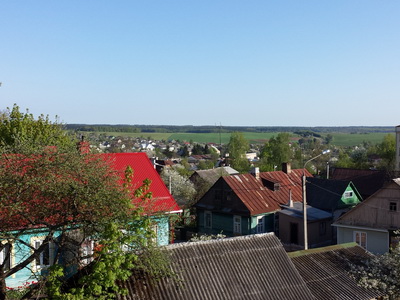
Novogrudok hill views today, 2015
In 1253 Novogrudok witnessed a landmark occasion: Mindoug (Mindaugas the Great for Lithuanians) got crowned in the city which made it the first capital of the Grand Duchy of Lithuania (until 1323 when this role was assumed by Vilnius). The man waged multiple wars some of which were lost, but most were victorious. His successors started building a mason castle in Novogrudok while building the huge empire of the Grand Duchy that included Belarus, Lithuania of that time and some other lands.
The country’s (and the city’s) growth was dwarfed by frequent invasions by crusaders and Tartars. To protect from these the residents of Novogrudok kept upgrading the castle which was only taken by the Swedes in 1706. In 1422 in the parish church a marriage took place between Yagailo, the King of Poland, and Sophia Golshanskaya which resulted in the establishment of the Yagellon dynasty. Novogrudok was also a ground to stage the country parliament sessions and the receptions of foreign embassies.
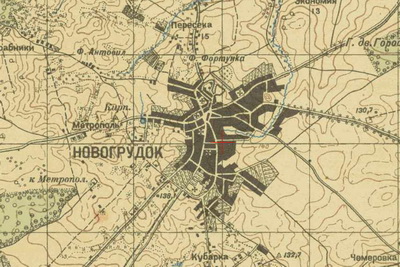
An old map of Novogrudok, 1900s...
Russian Orthodox eparchy started functioning in Novogrudok from 1316 and since 1596 it was also the headquarters for the Uniate Church authorities. In 1507 Novogrudok Voyevodstvo (district) was established including three localities: Volkovysk, Novogrudok and Slonim. It lasted more or less until 1940.
The city benefited majorly from Magdeburg right granted to it in 1511 – the locals could elect magistrate and were less dependent from the central authority. Generally, that boosted the trade with weekly markets and two annual fairs and saw the city growing. Church fraternities started building schools, the first theatre appeared and the gentry held their sessions and court hearings in Novogrudok in the 16 century. The city center was shaped around the town hall where richest houses were built for the magistrate.
In 16 century Novogrudok had about 3000 dwellers, gentry and city residents but mostly peasants surviving by ways of farming. Craftsmen and merchants made the basis for the town’s economy. Tartars and Jews start settling here altering the geography of the city, a mosque and a Muslim cemetery were built. In the late 16 century there were a wool manufactory, a wax factory, a mill and a brick factory in Novogrudok. The flock attended 10 churches, a synagogue and a mosque.
Wars, fires and epidemics of the 17-18 centuries dwarfed the growth of Novogrudok – e.g. in 1751 half of the city was wiped away by fire. A few decades later a traveler noted that most buildings in town were wooden with only a few masonries.
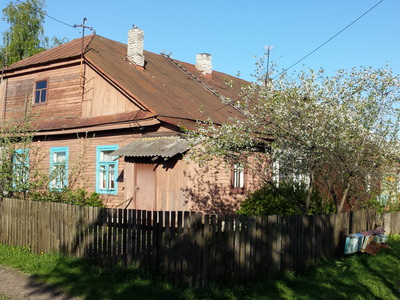
An old dwelling building in central Novogrudok
1795 saw the third partition of Rech Pospolitaya with Novogrudok passing to the Russian Empire, its nobility taking active parts in revolutions against the Russian takeover. The Russian authorities started rebuilding the city though the street plan remained the same. In 1837 the city had 441 building, in 1858 – over a hundred shops in the main square. There were no big industries until the late 19 century in Novogrudok hence its comparatively rural outline.
In 1897 over 13 000 residents were listed as living in Novogrudok. Their houses normally featured fruit trees and vegetable gardens and development was in many cases sporadic. Areas behind the city were owned by the gentry, church, city dwellers. Another fire made them build more masonries, so before WWI the city center was mostly built in stone.
1901 Gubernia book lists the members of Novogrudok Firefighting Society: Mrrs. Nikolay Peiker, Erast Sukovsky, Semen Zhytnikov, Moisey Slutsky, Shmerel Shapiro, Yosel Slutsky, Zissel Izraelite...
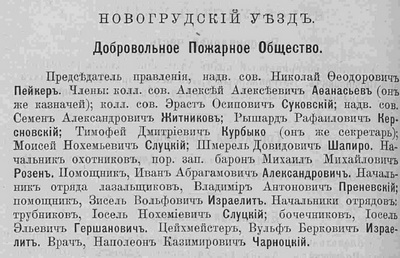
Novogrudok Uezd mentioned in the Gubernia Book, 1901
Since 1915 German occupation was replaced with Polish one with two brief takeovers by the Bolsheviks. However, Western Belarus was taken over by the USSR only in 1939 becoming one with the Belorussian Soviet Socialist Republic. Throughout all these events Novogrudok kept on being a district center.
The Great Patriotic War (1941-1945) destroyed around 45 000 people in the district. Occupied by the Nazi from July 1941 the area of Novogrudok famous for its thick forests became a stage of vicious resistance from the part of the partisans. Many forest teams were waging guerilla war with the Nazi – first for the sake of their own survival and later – to liberate the country. Many fighters died in action or in death camps, while many civilians were destroyed in the camps and ghettos or taken to Germany as forced labor. After the latter took place in July 1944 the tedious rebuilding of the whole area from ashes was underway.
Over years its population grew from 12 000 in 1959 to 20 000 in 1970. Today about 30 000 people reside in Novogrudok, a pretty ordinary provincial town of Belarus with the ruins of the historic heritage casting shadows suggesting of the grand events of the town’s past.
If you are interested in Novogrudok city tour or Novogrudok (Nowogrudek) family research - please, don't hesitate to contact me.
Flying over Novogrudok
|
|
Questions are welcome!


Featured
Applying at their local Belarus Consulate, the citizens of migration-secure states (e.g. the USA, Canada, Japan and others) can obtain a short-term...
The form of application for a visa to Belarus has become digital and you can save and send it as a PDF file. It is only a 2-page document that is available...
Quite a number of things, as a matter of fact. Let’s examine a typical case from my travel agent’s past with a traveler landing in Minsk Airport (MSQ) and applying for a visa...
People, who want to travel to Belarus to see a friend, take care of the grave of a relative, take part in the court hearings, etc. need to apply for a private visa...
This article covers field family research in Belarus that in most cases comes after dealing with the State archives of Belarus and genealogical research.
A plastic card is a fine thing, no doubt, but there have been a number of cases when the ATM displayed ERROR, or required a PIN code...
While most tourists agree that Belarus is not the country for grand shopping, there are still some things that can be brought back as souvenirs...