About Belarus
Articles dedicated to Belarus history, Belarus politics, Belarus economy, Belarus culture and other issues and Belarus tourist destinations.Pinsk - nine centuries behind... Or ahead?
Just like in case with Minsk we really don't know when the city of Pinsk was founded. It was first mentioned in the chronicles under 1097 which serves as the starting point in the city history. It evolved from an ancient town on the left bank of the Pina River in the area where it joins the Pripyat.
The Dregovichy ethnic group settled in these areas full of swamps. The rivers and lakes were full of fish and the harsh terrain gave a natural shelter from invaders. Since the river was a part of the itinerary taking merchants from Scandinavian countries to the south the town profited from trade. Crafts were well-developed according to the archaeological findings of pottery, wooden and metal items in the Castle mound.
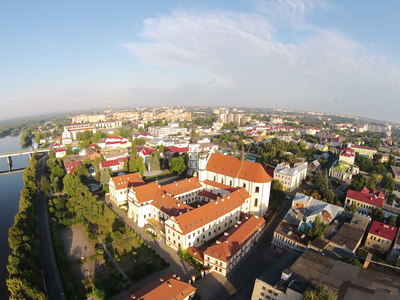
Pinsk Old Town air view (Franciscan Monastery), 2015
It became a major city of the Kievan Rus' and then the capital of an independent principality. Pinsk area joined the Grand Duchy of Lithuania in the early 14th century. Until 1521 it was governed by the princes who managed to turn it into a feudal autonomy.
In 1521 Pinsk became the property of Bona Sforza who carried out a number of reforms so as to increase the profit from taxes. The administration was rearranged, old taxes hiked and new ones introduced. As the land reform was underway the list of 800 landowners was compiled. According to it, there were 20 streets in Pinsk.
After the union treaty signed between the Polish Kingdom and the Grand Duchy of Lithuania the feudal and religious discrimination exacerbated. All power within the state became focused in the hands of the richest noblemen. After a long struggle the city residents managed to obtain Magdeburg right for Pinsk (1581).
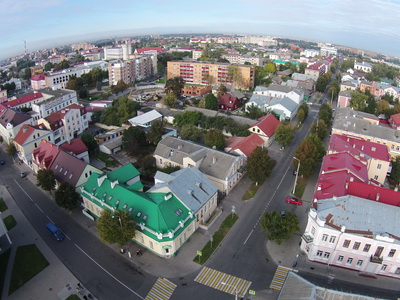
Pinsk architecture mostly survived the war and the city center is a splendid walking ground
Jesuits were invited in 1635 to build a monastery and a church. The giant catholic church of St. Stanislav was the largest one in the country. Along with it there were 10 other Catholic, Russian Orthodox and Uniate churches in Pinsk. Religious tensions were mounting and the uprising of Bogdan Khmelnitsky in Ukraine sparkled in 1648 to erase the Catholic and Jewish communities of Ukraine and Southern Belarus. According to some estimates, as the city was being liberated from the rebels about 5000 buildings (mostly wooden) burned down.
It took the city a long while to revive and the Russian-Polish wars that followed were not conducive to that. The residents only started rebuilding the churches, monasteries and dwelling houses when the Northern war broke out between Russia and Sweden. During the brief occupation of 1706 the Swedes pillaged Pinsk entirely. In 1793 Pinsk became the center of a county (uezd), a part of Minsk region that was it its turn the territory of the Russian Empire.
After the destruction of 1812 Pinsk was swiftly restored. In the 1830s the city had 22 streets and over 900 dwelling houses. In 1858 the city numbered over 11 000 residents. Pinsk evolved into a major transportation and trade hub. Dneper-and-Bug and Oginsky Canal crossed the city with cargos (salt, timber, wheat, potash, etc.) being transported as far as Poland. By and by feudal farming gave way to the capitalist economy.
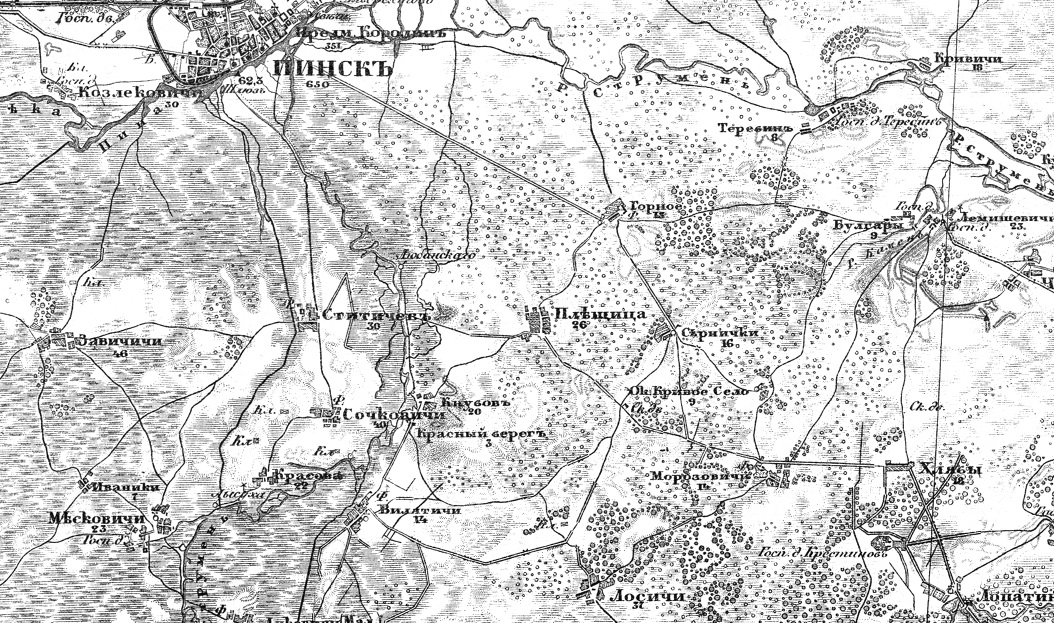
Old Russian map of Pinsk, 1870s
Now a part of the Russian Empire Pinsk was turning into a production center. In the 1850s Pinsk only had a few major enterprises producing soap, tobacco, beer and butter. Trade accounted for most of the income of Pinsk with over 300 shops located across the city. The embankment of the Pina was covered with multiple bags with wheat, tobacco, fish and other goods standing by shipment to Western Europe.
The construction of the railroad in the 1890s boosted the growth of the city. Major woodworking factories were established in Pinsk in the 1880s and in 1884 - the only factory in Belarus producing steamers. Apart from these major operators there were 40 smaller factories and dozens small workshops employing most of the city's population: leather makers, boot makers, carpenters, etc. In spite of obvious economic growth early capitalist enterprises had infamous working and living conditions of their labor force. Industrial growth went hand in hand with economic growth - several banks had their branches open in Pinsk in the early 1900s.
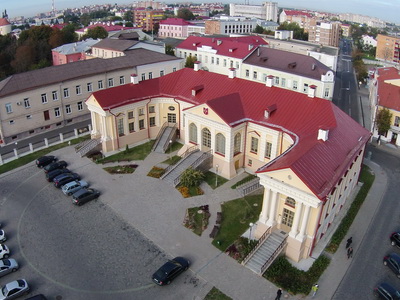
The palace of Butrimovich in Pinsk, 1790s
In 1873 the population of Pinsk was 18 670 people, in 1897 - over 28 000. People were mostly illiterate with only a gymnasium and a private girl school operating in the 1850s.
Low living standards and discrimination forced the creation of the trade unions, strikes and eventually to the first Russian revolution of 1905-1907. In spite of rigorous countermeasures from the government the society gained some basic rights and liberty.
A few years of comparative stability were followed by the disastrous events of WWI. Action forced many people away from the frontline area which settled in Pinsk by 1915. The German troops efficiently exploited the area resources exacerbating the levels of deprivation. Thousands of people were taken to Germany for forced labor.
1917 October revolution led to negotiations and later - to a peace deal between the Kaiser Germany and the Soviet Union (1919). In between the renewed German-Soviet war (1918) and Polish-Soviet war (1920) devastated the country again. The Soviet power was restored briefly in 1919 but then between 1921 and 1939 Pinsk was under control of Poland.
The Polish-occupied Western Belarus was converted into an agricultural appendix of Poland. Industrial enterprises were cut short and vast strips of land were handed over to the retired Polish officers to make sure they promote the interests of the government. Polish language was introduced at schools replacing Belarusian or Russian, Catholic Church was taking over the buildings of the Russian Orthodox Church. The population of Pinsk dropped to about 23 000 people.
In 1939 the Soviet Union took over Western Belarus which the poor mostly interpreted as liberation, the rich - as occupation. Belarus - or Soviet Belorussia at that time - became a single state. Soviet ways were introduced and capitalist ones - eradicated, sometimes in very harsh ways: thousands of people who failed to flee Western Belarus and were too rich by the standards of the Communists ended up in Siberia or dead.
1939 Soviet take-over did bring free all-public schools and revival of industries everywhere including Pinsk but the way the economy was organized is arguable to this day.
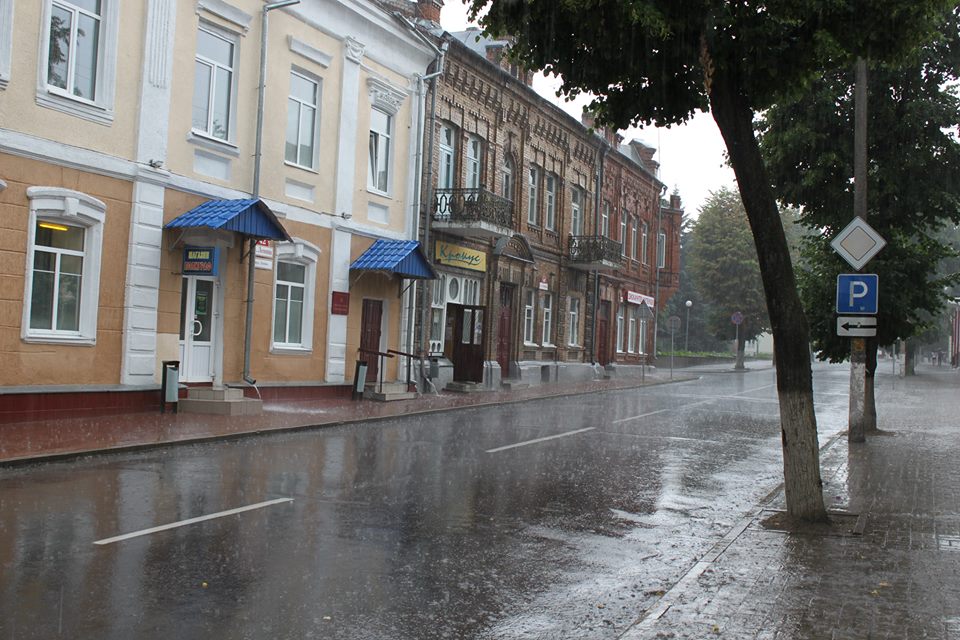
Gaz in Pinsk in the summer rain - Yiddish for "main street"
In 1941 the Nazi occupation followed and quickly spread through Belarus introducing the New Order. The area population became actively engaged into partisan and undercover activities that included sabotage acts, counter-propaganda and armed resistance itself.
Throughout the occupation about 65 000 people - the residents of Pinsk and the area - were eliminated or extracted to Germany as labor force, including about 28 000 Jews from the two Pinsk ghettos. The nature of the landscape - in the prewar times swamps stretched as far to the north as Minsk - made the liberation particularly painstaking. However, sustaining terrific losses the Red Army liberated Pinsk and moved on to capture Berlin on 8 May 1945.
Several memorials were installed to the city population, including to those who collapsed in the Jewish ghettos of Pinsk. The memorials can be found outside the city.
It took another considerable effort to remove the ashes of badly-damaged Pinsk and restore the city back to normal. Only 5 000 locals survived and about a half of the city’s dwelling houses that required renovation badly were not enough to accommodate them. Gross shopping deficit was also the case until the early 1950s (when deficit became moderate). Falling back, the Nazi blew up all the factories which had to be restored from scratch.
Today Pinsk is the 10th largest city in Belarus in terms of population which exceeds 100 000 people. There are dozens of factories that make a considerable contribution to the country’s economy and well-developed social infrastructure. Because of the its southern location in Belarus, Pinsk with the area became a significant player in the country’s agricultural market.
Everything seems to have been restored from scratch except for the Jewish community of Pinsk which almost entirely perished during the Great Patriotic War.
If you wish to tour Pinsk to trace your Belarus genealogy or just take a Pinsk city tour (as long as I am in the area) – don’t hesitate to drop me an email. I’ve already been around, I have the maps, I know a few good people)
Main Pinsk Streets
|
|
Questions are welcome!


Featured
Applying at their local Belarus Consulate, the citizens of migration-secure states (e.g. the USA, Canada, Japan and others) can obtain a short-term...
The form of application for a visa to Belarus has become digital and you can save and send it as a PDF file. It is only a 2-page document that is available...
Quite a number of things, as a matter of fact. Let’s examine a typical case from my travel agent’s past with a traveler landing in Minsk Airport (MSQ) and applying for a visa...
People, who want to travel to Belarus to see a friend, take care of the grave of a relative, take part in the court hearings, etc. need to apply for a private visa...
This article covers field family research in Belarus that in most cases comes after dealing with the State archives of Belarus and genealogical research.
A plastic card is a fine thing, no doubt, but there have been a number of cases when the ATM displayed ERROR, or required a PIN code...
While most tourists agree that Belarus is not the country for grand shopping, there are still some things that can be brought back as souvenirs...