About Belarus
Articles dedicated to Belarus history, Belarus politics, Belarus economy, Belarus culture and other issues and Belarus tourist destinations.
Stalin Line construction
updated on 27/11/2011
Stalin Line was never referred to like that in the USSR. One of the largest defense systems in the history of mankind, it consisted of a chain of fortified areas that stretched along the old border of the USSR, almost connecting the Baltic and the Black Seas. On the one hand, a 1200 km-long defense line was hard to bypass, on the other – the system of fortifications was rather thin for a good defense. In terms of engineering Maginot Line was superior to Stalin Line but the latter served its purpose much better.

Cannon pillbox in Stalin Line
The name Stalin Line came from an article in a Latvian newspaper. After the article was republished by The Daily Express
the Stalin Line term became widely used.
The construction of fortifications of Stalin Line started in 1928 and lasted until 1939. As a result 23 fortified areas that included over 4000 gun emplacements were built. The fortified areas designed to cover particular strategic directions were from 35 to 150 km long and in most cases were fitted with machine guns.
All fortified areas had similar features. An average area had a 35-50 km-long front and was armed with cannons and machine guns. The fortified areas were divided into smaller sections that consisted of 18 to 20 gun emplacements manned by infantry battalions. The distance between the pillboxes – normally 500-600 m – was covered with flanking fire.
Some concrete gun emplacements were designed for all-round defense with an accent on frontal fire. The most widely built pillboxes were appointed with 3 machine guns. Those fitted with cannons normally featured two 76 mm guns. Along with these they also built antitank pillboxes and smaller machine-gun emplacements.
In 1938 the USSR built 8 more fortified areas with over 1000 pillboxes out of 2000 that had been designed. The construction sites were abandoned in 1939 because the new Soviet border shifted 250-300 km westwards. The majority of ready-made bunkers were mothballed with the guns dismantled and the crews committed to other destinations.
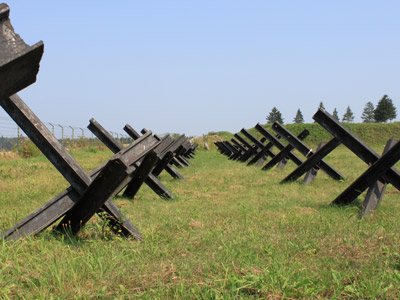
Antitank obstacles - the hedgehogs
Four fortified areas of Stalin Line were built across the territory of Belarus and in total featured 966 pillboxes. The strongest one was Minsk Fortified Area that actually covered Moscow highway. Minsk Fortified Area of Stalin Line was 140 km long. Its frontal defense was 6 km deep and beside the pillboxes themselves it included a vast network of roads, obstacles, trenches and communication lines.
Most of the Minsk area pillboxes were armed with Maxim machine-guns mounted on tripods. Also there were anti-tank bunkers fitted with turrets taken from decommissioned T-26 tanks. The pillboxes that were immensely strongly built of reinforced concrete had 1.5 m thick walls and 1.1 m thick roof that could sustain the hits of 152 mm artillery shells. The pillboxes were appointed with air filters, ventilation systems, periscopes, voice command pipes and telephones.
The German invasion into the USSR came unexpected. Therefore most Minsk area pillboxes of the Stalin Line had not been manned by the Red Army forces before the Nazi reached the capital of Belarus. Stalin Line fortifications in Minsk area have not been engaged in heavy clashes to become an open air military museum, one of the destinations of my
guided Minsk tours.
Featured
How do I apply for a Belarus tourist visa?
updated on 13.02.2017
Applying at their local Belarus Consulate, the citizens of migration-secure states (e.g. the USA, Canada, Japan and others) can obtain a short-term...
Filling in Belarus visa application
updated on 18.02.2020
The form of application for a visa to Belarus has become digital and you can save and send it as a PDF file. It is only a 2-page document that is available...
Tour Belarus for family research
updated on 16.05.2013
This article covers field family research in Belarus that in most cases comes after dealing with the State archives of Belarus and genealogical research.
Using a plastic card in Belarus?
updated on 14.10.2016
A plastic card is a fine thing, no doubt, but there have been a number of cases when the ATM displayed ERROR, or required a PIN code...
Traditional souvenirs from Belarus?
updated on 18.10.2016
While most tourists agree that Belarus is not the country for grand shopping, there are still some things that can be brought back as souvenirs...


